
Fayette County Deed Records by Instrument
Recording a deed places the transfer document in the public land-record system. That act is evidence of filing, not proof. Nor does it show that title is clear of every claim. The Fayette County index holds more than deeds. Deeds of trust, mortgages, releases, liens, leases, and plats sit beside them. So do powers of attorney and wills. The table separates common deed forms from other entries. Those entries often appear next to a transfer.
| Deed Type | What It Does | Common Use |
|---|---|---|
| Deed | Records a transfer described by the instrument | Read parties, legal description, and terms |
| Affidavit of descent | Records an estate or intestate transfer fact | Follow with probate and later deed entries |
| Executor or fiduciary deed | Shows a transfer by an estate representative | Check the estate authority and grantee |
| Condo deed or correction deed | Transfers or corrects a described interest | Compare the related plat and prior entry |
| Mortgage/deed of trust | Records security for an obligation, not a sale | Look for later assignment or release |
Mortgages and liens live in the same land-record system as deeds. Neither one transfers ownership. An assignment moves a loan right to a new holder. A later release or satisfaction may clear that specific instrument. Plats change the lot context for a parcel. An easement can affect use without changing the owner of record, so search each instrument group separately instead of reading every indexed entry as a sale.
Fayette County Deed Index Search Fields and Modes
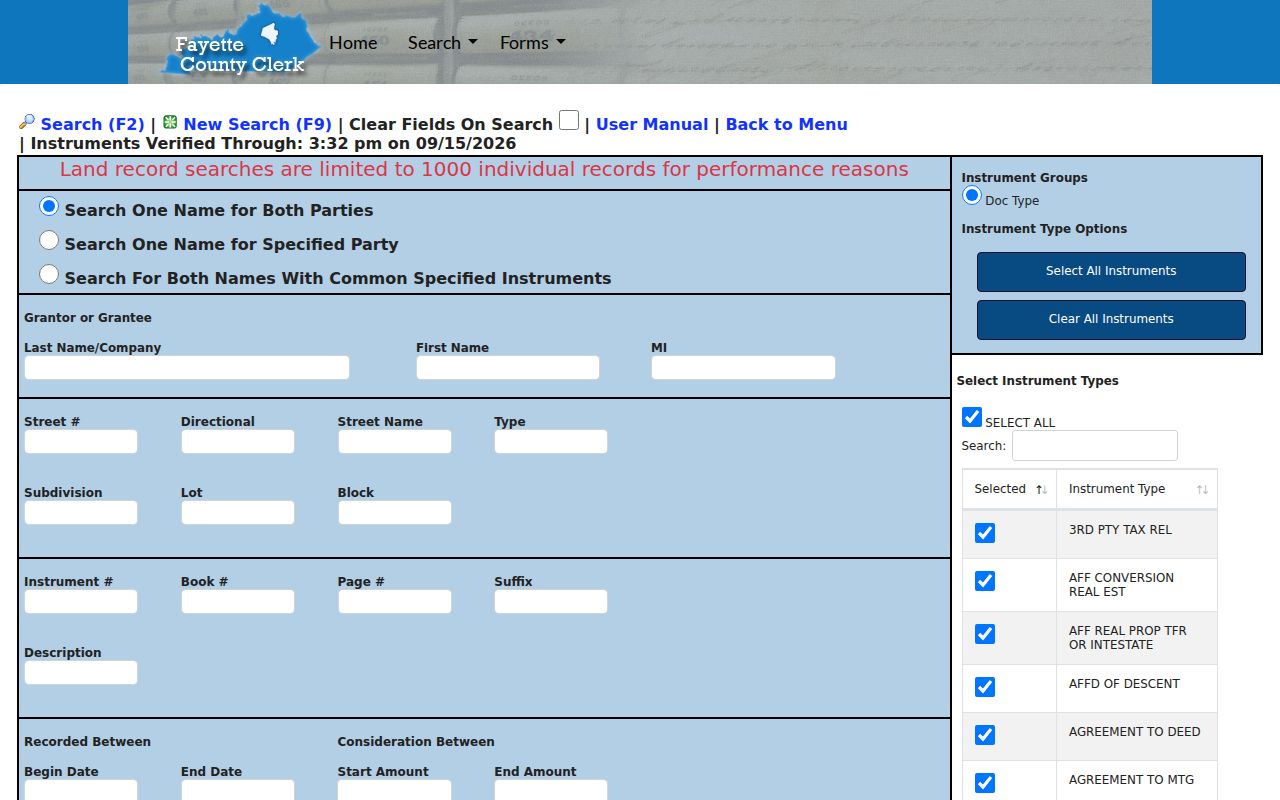
FayetteDeeds offers three party-search modes. You can run a name against both roles at once. You can also name just the grantor or just the grantee. The third mode pairs two names with common instrument types. Because every field is optional, a broad query pulls back plenty of noise; adding a date range and instrument group makes the results far easier to review.
| Field | Type | What it narrows |
|---|---|---|
| Grantor / Grantee name, first name, middle initial | Party text | Transferor, recipient, or company name |
| Street number, directional, street name, type | Property text | Address clues when the situs is known |
| Subdivision, lot, block, description | Legal/property text | Plat references and written land descriptions |
| Instrument number, book, page, suffix | Record key | A known clerk reference |
| Begin/end date and start/end amount | Date and consideration ranges | Recording window or stated amount |
| Instrument groups and selected types | Checkboxes | DEED, MTG, LIEN, RELEASE, PLAT, WILLS, and more |
Dates go in month/day/year order. The portal shows Search, New Search, and Clear Fields On Search controls, with separate routes for Non-Indexed Documents and the Daily Notebook. The official guide lists many more types. Affidavit of descent, easement assignment, declaration and trust, delinquent-tax release, condo plat, fixture filing, and power of attorney all appear there.
Read the Fayette County Deed Party Index
The grantor conveys an interest; the grantee receives it. To trace a parcel, start with the latest assessor owner or a recent deed grantee. Note the description, deed reference, date, and grantor. Then search that grantor as a grantee. That step reveals the prior acquisition, so repeat it until the modern online index ends and the historical books take over. Fayette County's older records continue the chain. The County Clerk's land-record system files deeds, mortgages, releases, liens, and plats together, so use the instrument-type filter. It separates true transfers from the rest. Some filings only record a lien, security interest, correction, or later release without conveying the parcel.
- Search the known owner as grantee and identify a likely deed by parcel description and date.
- Read the deed image for the grantor, grantee, legal description, book/page, and instrument number.
- Search the prior grantor as grantee, then compare the older description with the same tract.
- Check other recorded types, such as release, plat, estate, or mortgage, when the chain changes shape.
- Move to the older book route when the online index or image range ends.
- Grantor
- The party who conveys an interest.
- Grantee
- The party who receives the interest.
- Chain of title
- The sequence of recorded transfers tied to the same land.
- Book and page
- A volume location; the instrument number is another record identifier.
Fayette County Deed Index and Image Years
Index coverage and image coverage start at different points in Fayette County. The deed index reaches back to 1981. Online images begin in mid-1989. A deed can therefore have a discoverable index entry with no image attached in the same route. Use the record-room copy service for a document you identify but cannot display. Search results cap at 1,000 records. The portal also shows an "Instruments Verified Through" timestamp. A common-name search should be narrowed by party role, date, and instrument type. Try alternate entity styles. Search names with and without a middle initial. When a chain depends on a specific lot, use the legal description, subdivision, lot, and block fields instead of an address that may have changed.

Fayette County’s Older Deed Books
The County Clerk's guide maps the older deed books. Deed and mortgage indexes run from 1794 through 1903. Old deed books A through Z cover the late 1700s to September 1825, with numbered books beginning in October 1825. Books 229-980 span 1925 to 1970. Partial books 981-1392 reach into 1986. Historic categories add surveys, land treasury warrants, partition lands, county court orders, and a short property-tax-book run from 1807-1808. To reach an older route, open FayetteDeeds and choose the non-indexed-document path. Select the book type. Then search the alphabetic grantor or grantee index for a book and page. The guide describes six-character volume keys and image page suffixes for repeated page labels. Record the exact key as displayed. Fayette County's online cutoff does not mean the land records begin in 1981; when a transfer predates the index, the older books are the next step. One quirk is worth noting. No Minute Book 5 appears in the historic city-minute sequence, the guide says. Follow the archive's actual labels.
Fayette County’s 1893 Deed Record Gap
Fayette County's courthouse fire of 1893 sounds like a research dead end. It was not. An Archives and History account confirms the later courthouse burned. Record loss, however, was partial. The County Clerk still catalogs deeds, surveys, burnt-record books, and court orders. Marriage material reaches back to the county's 1831 formation as well. Birth and death records have larger pre-1866 gaps. That limit sits apart from deed-book coverage entirely.
An early transfer may fail to appear in the modern index. Do not assume no record exists. Try the historic alphabetic index and the book inventory first. Search tract descriptions and family or estate names. Then compare findings against probate, tax, newspaper, survey, and library sources. An index gap is a reason to widen the source set. It is not a claim that the land went unrecorded.
Fayette County Deed Copy Requests and Fees
Deed copy requests in Fayette County start with the Clerk's copy form. The form works best when filled in with whatever identifying details the requester has. That can be a book and page number, a control number, or a recording date. Document type, party names, and the property address also help. Requesters choose between an ordinary copy and a certified copy. They then add contact and mailing information.
Fees are simple. An ordinary copy runs 50 cents per page. A certified copy costs $5 for the first three pages. Each additional page is 50 cents. Postage and handling is $1 per document.
Some submission and payment addresses do not appear in the PDF. Call the County Clerk before mailing anything. The office sits at 100 North Court Street in Fayetteville. The County Clerk can be reached at 304-574-4327, and the record room at 304-574-4262. For an existing public record held by a different custodian, W. Va. Code §29B-1-3 allows a narrow written request. That statute does not force an office to search title. It also does not require a new ownership analysis.

Request a Fayette County Deed Copy
A Fayette County deed that appears as an online image should be checked against its index entry first. The parcel description should be checked too, before anything else. If no image exists, the book and page or instrument information goes on the Clerk's copy form. Confirm the current submission route with the office. In-person deed access is available at the courthouse record room. Any copy request should name an existing document. Do not ask the Clerk to judge whether title is clear.
Recorded, not guaranteed. A Fayette County deed index shows an entry and points to a record. It is not a title opinion, and unrecorded interests or legal defects may require a title professional’s review.